
Budget First Isn't Less Romantic. It Is More Honest.
There is a moment we have seen too many times in this industry. A homeowner spends months with a designer they love, watching beautiful drawings take shape, choosing finishes, growing more invested with every meeting. Then the bids come back, and the number is nowhere near what anyone expected.
What happens next is where remodels go wrong. It isn't in the framing or the finish work, but right there in the gap between the design and the budget. Because when the real numbers arrive too late, homeowners are left choosing between heartbreak and a handshake with whoever promises the impossible.
We built our process specifically so our clients never have to stand in that gap.
How we work: Design-Integrated Build
At Blue Sound, homeowners can engage us as their builder at the very beginning of the project, before design rather than after it, with a small initial deposit. From there, the work unfolds in a particular order for a reason.
Clarity: We begin with a real conversation about how you live, what you want, and what you are prepared to invest. It is a scoping conversation rather than a sales call, and the care we take here shapes everything that follows.
Relationship: We help you find the right designer, though the relationship remains entirely yours. You contract with your designer directly, so they work for you and answer to your vision. We simply connect you with designers whose sensibility fits your project, drawing on years of collaboration with the design community here in Seattle.
Experience: We shape the scope around your budget from day one, before pencils get too attached to ideas. Design happens inside real parameters instead of hopeful ones, and that single shift changes the character of the entire project.
Collaboration: And, most importantly, we stay at the table through every decision. As your designer works, we price in parallel, so that when you are weighing the plaster hood against the custom range surround, you are weighing it with real numbers rather than assumptions.
We call this design-integrated build, and it is a deliberate alternative to two more familiar models: traditional design-bid-build, where the builder shows up after the design is finished, and design-build, where a single company controls both sides of the process.
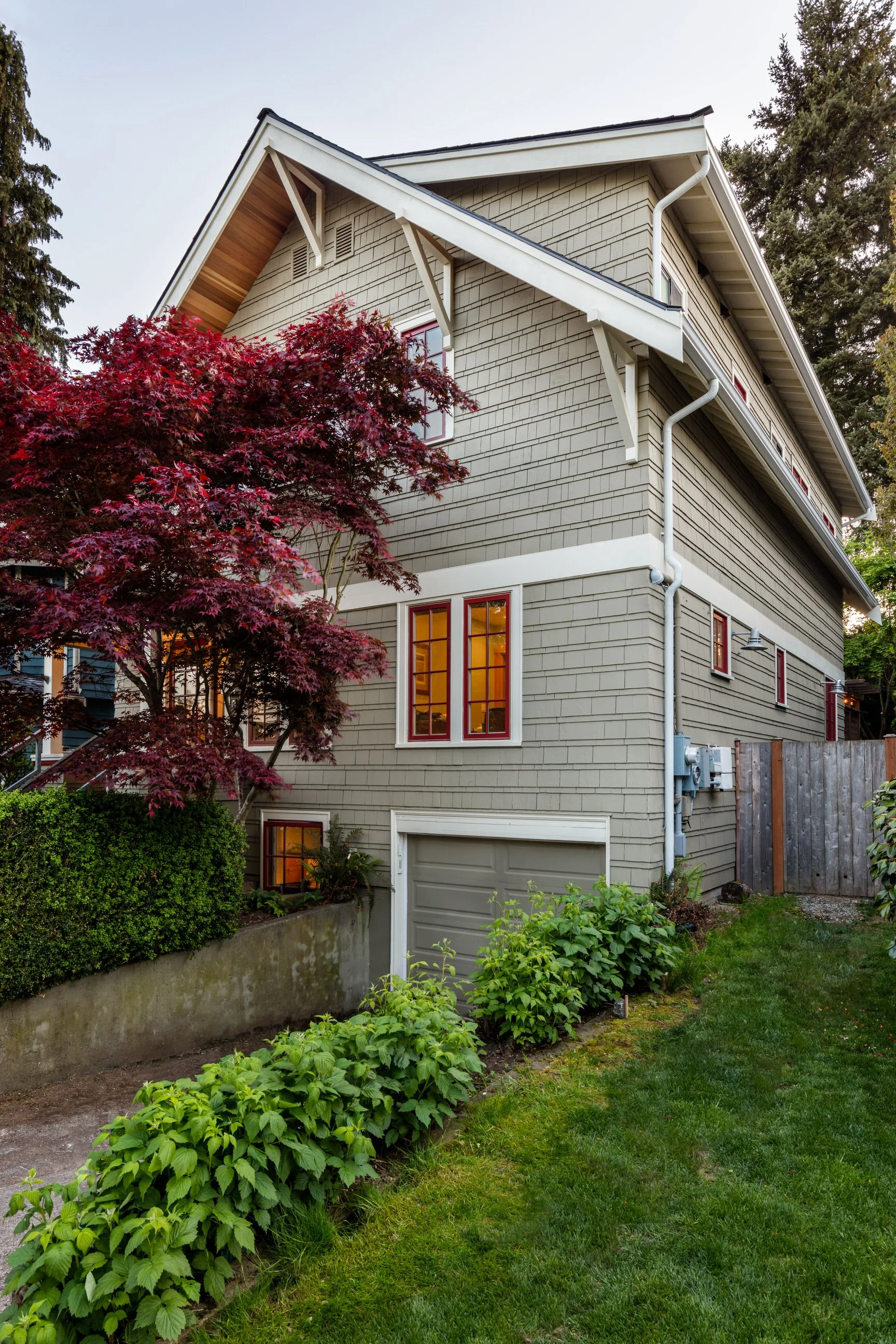
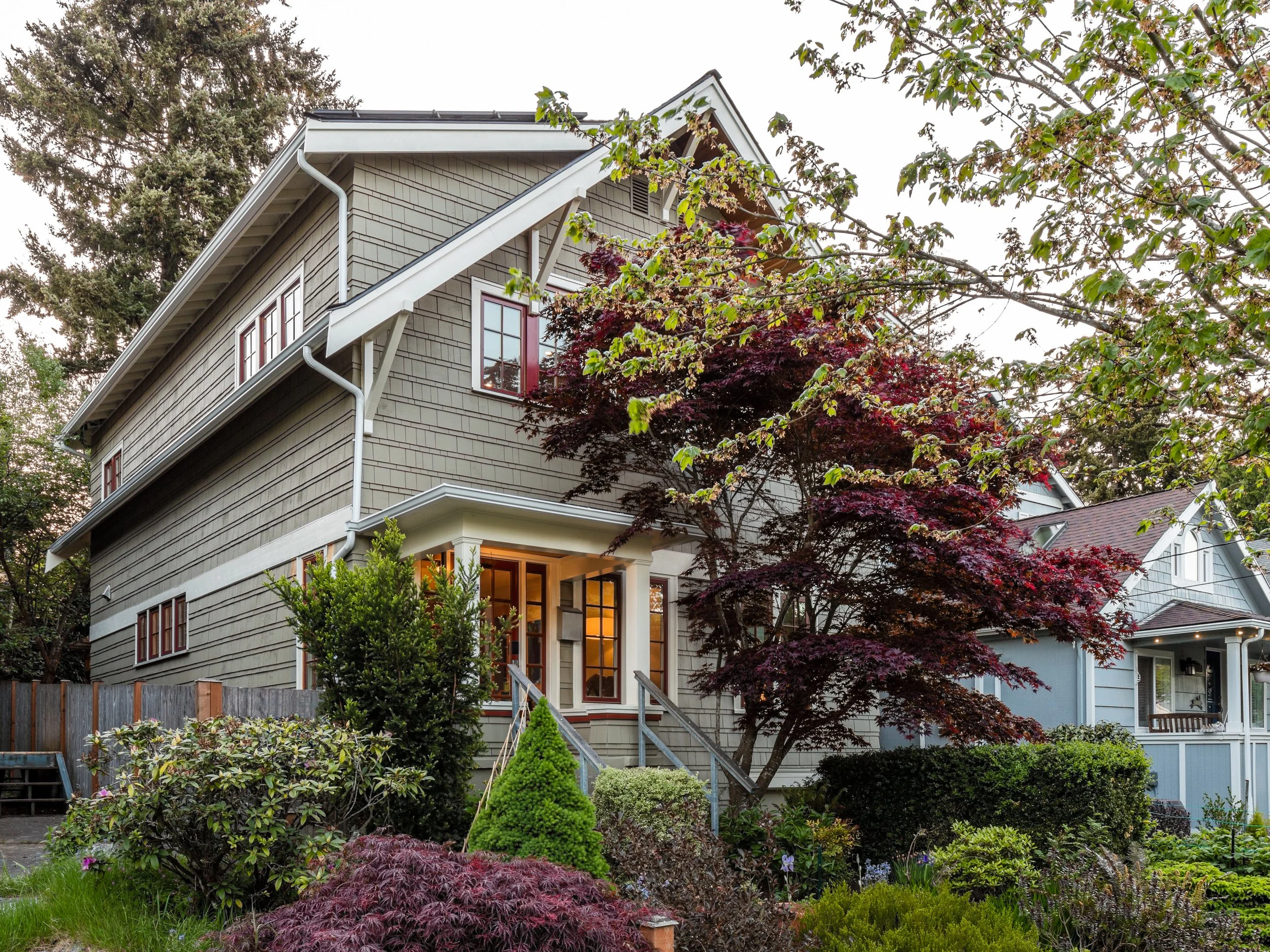
This charming second story addition on the home of a repeat client (previously we had made an addition to the back main story and basement) blends seamlessly with the neighborhood character. Neighbors regularly stopped by to comment on how pleased they were. The homeowner worked with Blue Sound to ensure the existing charm of the cedar shingle siding was included, as well as a quality investment in aluminum clad wood windows. These are the sorts of decisions you can preserve out ahead when working with a builder early.
Why not Design-Build?
Design-build promises simplicity, and sometimes it delivers. One contract, one team, “one throat to choke,” (yikes!) as the saying goes. But it carries tradeoffs that rarely get discussed openly.
Pricing is often opaque. When design and construction live inside a single contract, it becomes genuinely difficult for a homeowner to see where the money goes. What did the design cost? What is the markup on construction? What is padding? Often you simply cannot tell, and that is not necessarily an accident. Our cost-plus structure means you see actual costs and our actual fee at every stage of the project. Transparency beats false precision, and it certainly beats no visibility at all.
Design gets taxed. This is a detail most homeowners in our state never hear about. When design services are bundled into a construction contract, Washington treats them as part of the retail construction sale, which means retail sales tax applies to your design fees. In the Seattle area that tax runs roughly ten percent. When you contract with your designer independently, their fees are treated as professional services and taxed differently, so that sales tax simply does not apply. On a substantial design fee for a whole-home remodel, this is not a rounding error. It is thousands of dollars you would rather put into the work itself.
Design deserves independence. When the builder employs the designer, the design can quietly bend toward whatever is easiest or most profitable to build. We think of it as builder-basic: competent, buildable, and a little bit bland. Your designer should be free to push us, to insist on the arch, the inset cabinetry, the detail that makes the room sing. Our job is to price that ambition honestly and build it beautifully, not to talk anyone out of it. Keeping the design relationship independent keeps the design ambitious.
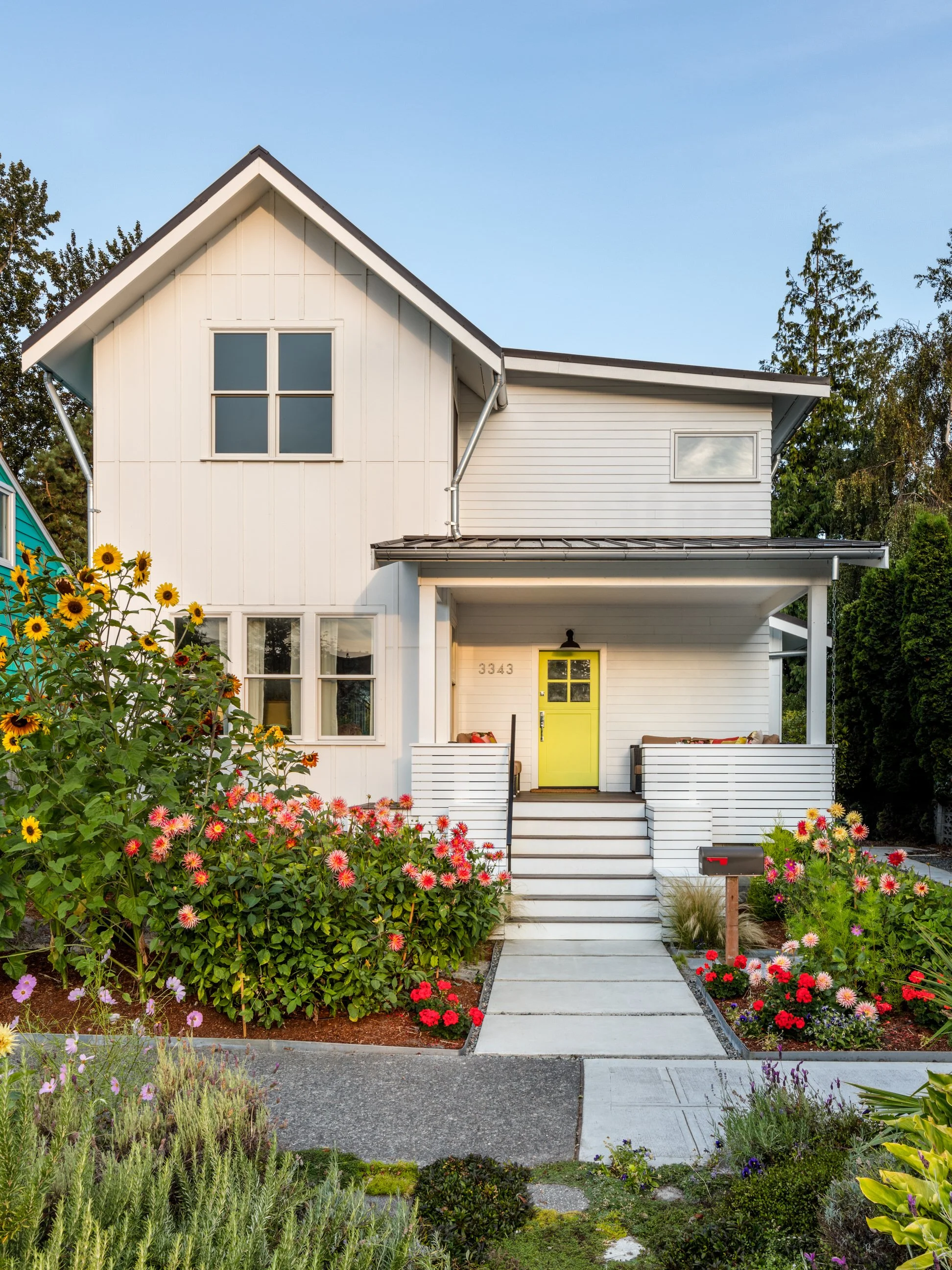
On this incredibly value-packed addition, Blue Sound scraped the original home down to the foundation and rebuilt two stories to remake this Alki modern farmhouse. The clients began with budget first, helping them identify that a scrape and rebuild was more cost-effective than remodeling. And then Blue Sound worked closely with the architect to ensure their scope wishes were honored while providing a design that feels both fresh and timeless, rooted in place.
Why not design first, budget later?
The traditional path carries the opposite problem. The designer works, the drawings develop, and the budget rides along on estimates, often the designer's best guess, offered in good faith but without a builder's current cost data behind it.
Then the project goes out to bid, and reality arrives. Here is the dangerous part: there is always a contractor willing to tell you the number you want to hear.
We call these false numbers, and they are one of the most damaging forces in residential construction. A bid that magically lands within a budget the design has already outgrown is not a bargain. It is a promise that will be broken somewhere you cannot see. Corners get cut and materials get substituted, and sometimes the savings come from places that put you legally and financially at risk: crews without workers' compensation coverage, unlicensed subs, insurance gaps that land squarely on the homeowner if something goes wrong.
Nobody sets out to hire that contractor. People end up there because they fell in love with a design before they knew what it cost, and the false number was the only way to keep the dream alive.
Putting the budget forward prevents the whole cascade. We know it is a less glamorous way to begin, but it means the design you fall in love with is one you can actually build, with materials that stand the test of time, use, and PNW winters, by people who are paid and protected properly.
“Then the project goes out to bid, and reality arrives. Here is the dangerous part: there is always a contractor willing to tell you the number you want to hear.”
What this looks like in practice
Because we are involved from the beginning, cost feedback happens during design rather than after it. Your designer sketches, we price, and you decide with real information in hand, before the drawings become expensive to change. The trade-off conversations happen when they are still cheap, on paper rather than on site.
That rhythm carries a important benefit as well. Most change orders are not caused by construction problems; they are caused by decisions made without cost information, unwinding at the worst possible time. When every selection has been priced as it was chosen, the build itself becomes remarkably calm.
Through it all, the alignment holds. Your designer advocates for the vision, we keep the numbers honest, and you make the calls. Nobody has an incentive to hide anything, because our structure does not reward hiding anything. Cost-plus means our books are open and our fee is stated plainly.
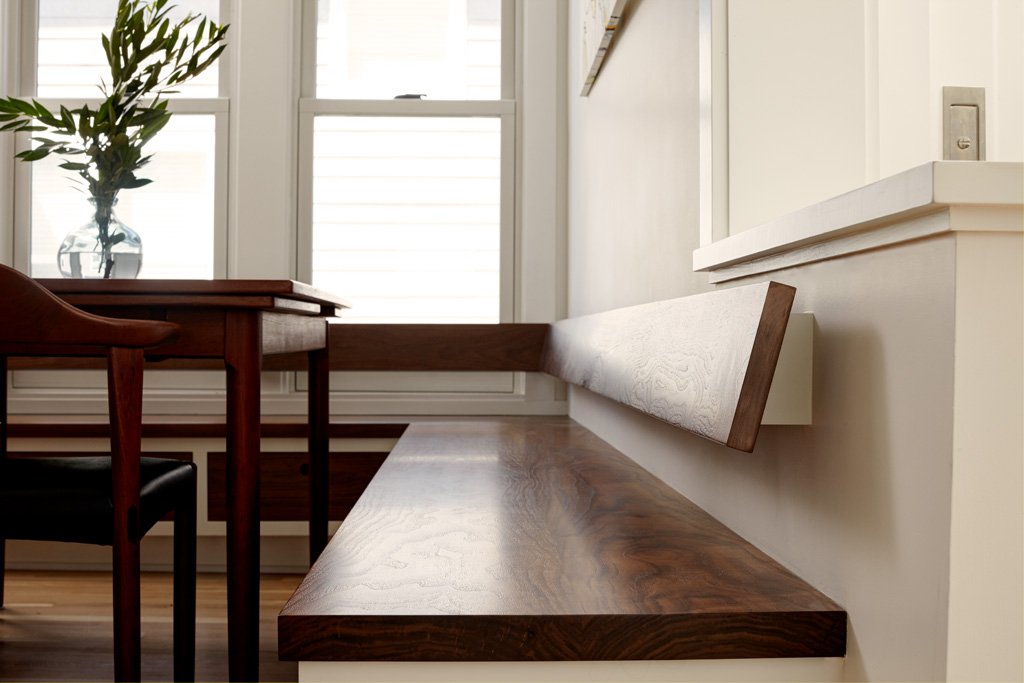
Even on smaller scale remodels, a collaborative approach maintains a feature rich home by exploring the realm of what’s possible in conversation between builder/ designer/ & homeowner before anything is drawn. Here a simple bench and back in a sumptuous walnut make room for added storage to maximize an otherwise compact urban footprint.
The small deposit that changes everything
All of this begins with a modest initial deposit, a fraction of what you would risk by going deep into design without a builder at the table. What it buys is expensive to get any other way: a scope shaped to your actual budget, a designer matched to your project, real pricing on every decision, and a team aligned around your goals from the first conversation to the final walkthrough.
We think of it this way. Everyone eventually finds out what their project really costs. The only question is whether you learn it at the beginning, when the knowledge is useful, or at the end, when it is just a bill.
We would rather you know from the start. That is the whole idea.
A note on Cost Planning.
For some projects, and some homeowners, it makes sense for the designer to hold the reins from the start. For those situations we offer Cost Planning, which follows the same sequence as design-integrated build but shifts the balance: your designer leads the process, and we support it with periodic budget checks whenever you or your designer request them. The transparency is the same, the real numbers are the same, and the protection against late surprises is the same. The difference is simply who sets the pace, and for design-driven clients who have more give in their budget/scope equation, it is often the more natural fit.
Blue Sound Construction is a Seattle-area general contractor specializing in whole-home remodels, historic restoration, and design-centric residential construction. If you are considering a project and want to talk through scope and budget before you go too far down the design path, we would love to hear from you.